



In the year AD 1577, a massacre took place in Uamh Fhraing, locally known as Massacre Cave, on the Isle of Eigg. Tradition states that almost 400 people were killed in the cave during the Clan feud between the MacDonalds and MacLeods. The recent discovery of human remains within the cave, which have been radiocarbon dated to between AD 1430-1632, provides possibly the first tangible evidence of this tragic tale.
Recent archaeological investigations were undertaken by AOC Archaeology on behalf of Historic Environment Scotland and Eigg History Society.
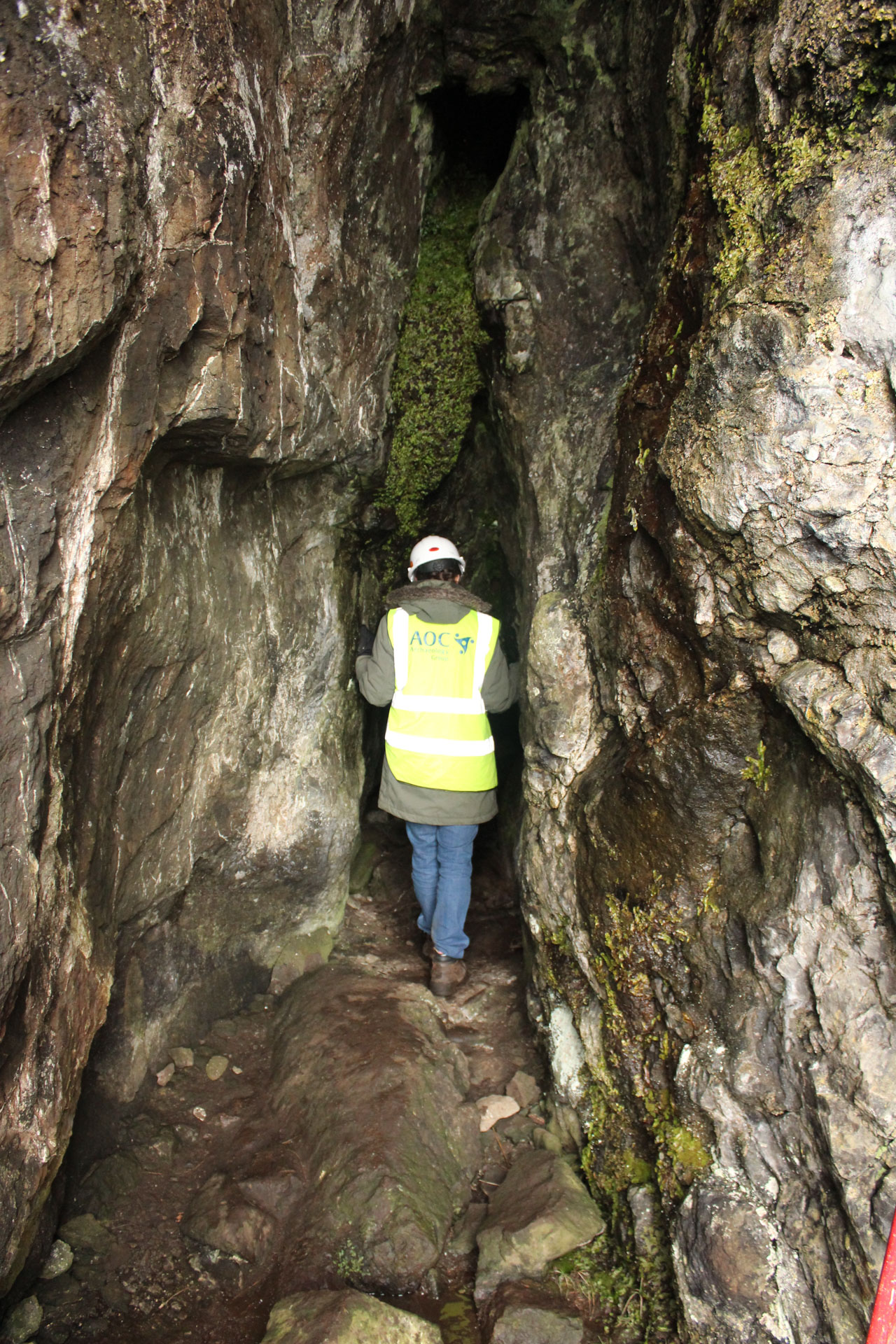
An archaeologist enters Uamh Fhraing, Massacre Cave. The narrow entrance is only this high for a very short distance, after which it becomes much lower, and it is not possible to stand.
The Story
The following story of Massacre Cave has been provided by Camille Dressler of the Eigg History Society and was inspired by the description of events by Professor John Hunter, who has led archaeological investigations on the island.
In the year AD 1577, the Eigg population of almost 400 people was annihilated in a gruesome event that occurred in the cave of Uamh Fhraing, which later became known as the Massacre Cave. This happened during a long period of disorder and violent feuding between the MacDonalds of Clanranald and the MacLeods of Harris following the collapse of the Lordship of the Isles in the 1490s.
Eigg Coastline near Eilean Chathastail
Photo by: @eiggadventures | Owain Wyn-Jones
The story of Massacre Cave began when a band of MacLeods sailing the waters near Eigg were forced by a storm to land on Eilean Chathastail near the southern end of Eigg. There, they encountered a group of women who were tending to their cattle. The MacLeods maltreated the women and killed and feasted on their cattle. However, the alarm was raised, and a force of Eigg MacDonalds came and attacked the invaders, killing all but one – Uilleam, the foster son of MacLeod of Dunvegan. Uilleam, with his limbs broken, was set adrift on a boat without oars for a slow and painful death.
However, Uilleam’s boat drifted towards Skye, where he was rescued by his kinsmen. Seeking revenge, a large party headed by Alastair Crotach, the chief of the MacLeods, was dispatched to Eigg. As soon as their sails were spotted, the entire population of Eigg sought refuge in their traditional hiding place: Uamh Fhraing, a cave on the south side of the island with a very narrow entrance.
After three days of fruitless searching, the MacLeods set out to leave, but when they rounded the coast towards Skye, they spotted a scout sent out of the cave. The MacLeods immediately turned around and returned to the island, where they found the scout’s footprints in a covering of fresh snow and were able to follow his trail back to the cave’s entrance.
Tradition tells that the MacLeods called for those who had killed their kinsmen to come out and the rest of the people would be spared. No one came out. Uilleam and his men then started to build a huge fire outside the cave’s entrance. The MacLeod chief hesitated, asking for a sign from heaven: if the wind blew from the sea, the fire would be lit; if the wind blew away, the people would be spared. The tide came in and with it a wind from the sea. The MacLeod chief sailed away, leaving Uilleam and his men to light the fire, suffocating all inside.
The entrance to Massacre Cave looks lovely on a bright dry day, but in reality, the cave is narrow, low, dark, and may experience rock falls. It is considered a burial site and should not be entered by visitors.
Photo by: @eiggadventures | Owain Wyn-Jones
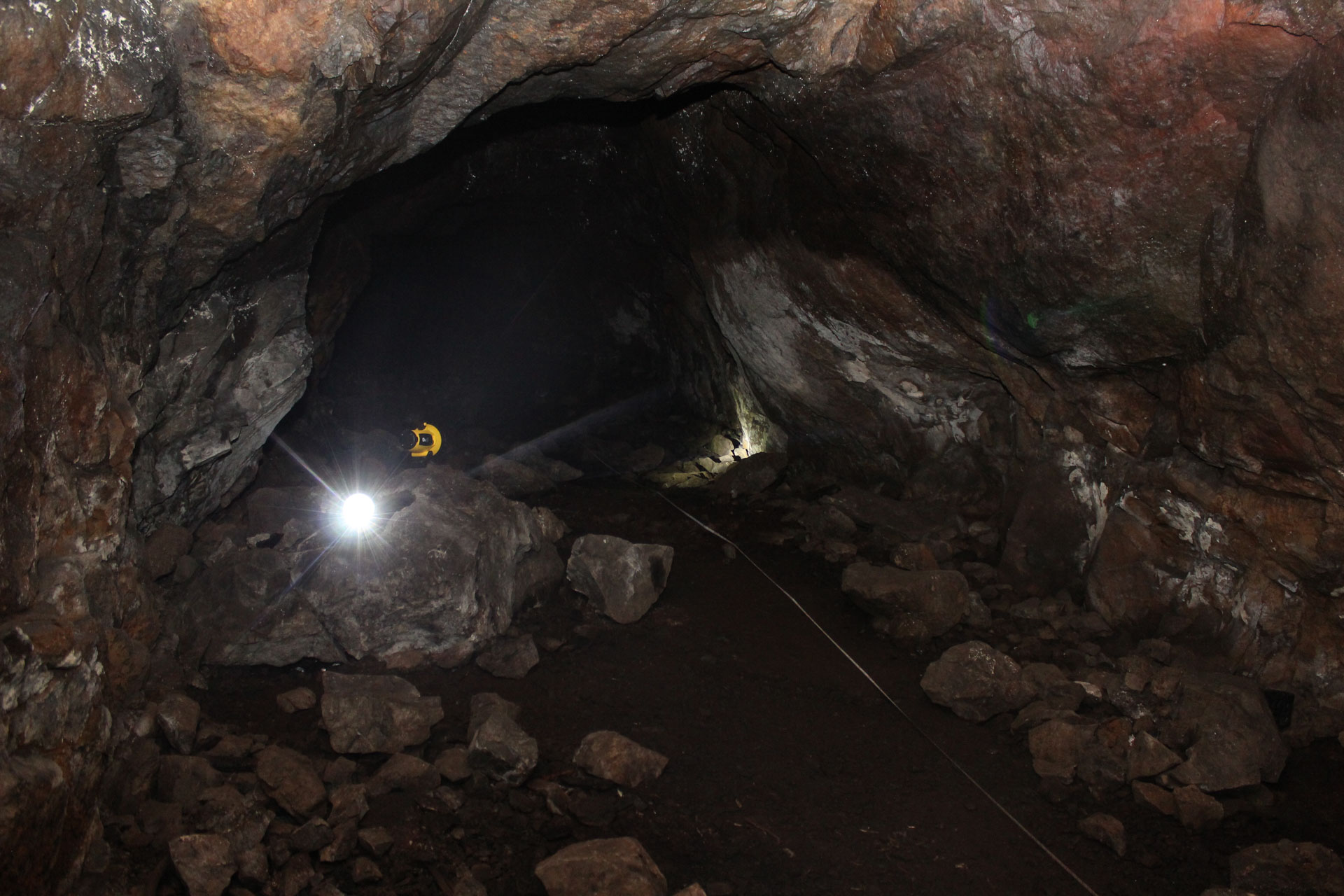
The dark interior of the cave, only visible through the use of high-powered lights.
The Lament
When the people of Clanranald heard how the people of Eigg all died in the cave, a lament was composed called:
‘S Trom an Direadh – ‘Sad is the climbing’
Faclan Gàidhlig
E hò a hò ‘s trom an dìreadh
Hi hoireann ò ‘s trom an dìreadh
E hò a hò ’s trom an dìreadh
’S fhads an sealladh bhuam a chì mi
Chì mi Rùm is Eig’ is Ìle
Far na rinn MacLeoìd an dìobhail
Dhòirt e fuil ‘s gun chaisg e ìotadh
Chì mi Barraidh an tìr ìosal
Chì mi Uibhist nam fear fialaidh
Far an dèanar an Fhèill Mìchail
Co ni sugradh co ni sugradh?
Co ni ’n gunna caol a ghiulain?
English Lyrics
Eh ho, ah ho, sad the climbing
Hi haran oh, sad the climbing
Eh ho, ah ho, sad the climbing
It’s far from me that I will see
I will see Rum and Eigg and Islay
Where MacLeod made his mischief
He spilled blood but his thirst was not quenched
I will see low-lying Barra
I will see Uist of the generous people
Where they still keep the Feast of Michael
Who will make sport? Who will make sport?
Who will carry the narrow gun?
Archaeological Evidence
While the story of Massacre Cave is widely known and has been written about on several occasions during the last 300 years, physical evidence for the massacre is scarce. Hugh Miller, who visited the island in 1846, reported finding “the bones of adults and children in family groups with the charred remains of their straw mattresses and small household objects”. During the Victorian period, tourists reportedly took souvenirs of human bones from the cave before the islanders intervened and arranged for the bones to be buried in Eigg’s graveyard.
In 2016, further human remains were observed. These were initially investigated by the police, who passed on the case to archaeologists after discovering the historic origin of the bones. Archaeologists carried out a detailed survey of the cave and retrieved any visible bones from the cave floor, though no excavations were undertaken. Two deposits of animal bones were recovered along with three more fragments of human bone to add to the fragments collected by the police.
An archaeologist works in the challenging, dark and cramped conditions of the cave. A colleague stands by the entrance as a safety measure.
The usually dark interior of the cave was lit by high-powered lights to allow archaeologists to investigate. The ranging rods provide scale and highlight the cramped conditions.
The Bones
The bones found in Massacre Cave in 2016 came from two individuals: one child and one adult. Bones from the child’s skeleton included parts of the skull, torso, right arm, hands and right pelvis, representing around 30% of the full skeleton. The shape and epiphyseal fusion of the bones indicated that the child was likely between 9-10 years old. The young age meant it was not possible to determine the sex. Only two bones from the adult were found, so it was not possible to estimate the sex or age of the individual.
Radiocarbon dating was carried out on bones from the two individuals, both producing similar calibrated date ranges of between AD 1430 to AD 1632. This range includes the date of the AD 1577 massacre, suggesting the possibility that these were two of the islanders killed during that event. Funerary practices in medieval Scotland typically involved traditional Christian burial within a churchyard, so the discovery of bones of this date in a cave is unusual. The fact that both an adult and child were present also supports the story of the massacre. However, the limited skeletal remains found cannot provide conclusive evidence for the massacre.
The location on the cave floor where the bones were found. The scatter of rocks have accumulated from rockfalls.
The small triangle of the entrance is usually the only light in the cave. The cave floor is covered in sharp rocks that have fallen from the roof and walls.
The Cave and the Community
The story of Massacre Cave has held great importance for the community of Eigg over many years, from those who composed the first lament in the aftermath of the tragedy to those who live on the island today. The mass deaths of so many islanders would have been an event of immense grief and sorrow that irrevocably changed the island and its people.
For those living on Eigg today, the cave is the focal point of an important historical event. The discovery of human remains in Uamh Fhraing provides the first physical evidence to indicate the death and/or deposition of two individuals within the cave during the late medieval period. Whether or not these people were killed during the massacre, the cave has been their resting place for hundreds of years and should be treated with respect.
In Situ wishes to thank Camille Dressler for her account of the story of Massacre Cave and @eiggadventures | Owain Wyn-Jones for permission to use his images of the Eigg coastline, Massacre Cave exterior and field of bluebells within this story.
