




Recent upgrades to Staffin Harbour and slip road on the Isle of Skye have encountered remnants of Mesolithic activity along the coastline. This area of Skye has long been recognised for its ancient origins, with the shell middens and rock shelter at An Corran thought to be at least 8,000 years old and used throughout many periods in prehistory. At the other end of the timeline, the project also recorded the ruins of several 20th century boat nausts, reflecting more recent uses of the harbour.
Archaeological works, commissioned and funded by Staffin Community Trust, included walkover survey, test pits, watching brief, and historic building survey. They were undertaken between 2022 and 2024 by AOC Archaeology.

Staffin Harbour
Staffin: A Timeline
Use the map below to scroll through a timeline of the ancient landscape around Staffin Harbour.
Archaeological Investigations
In 2022, works to improve the road and slipway at Staffin Harbour provided an opportunity to further investigate the archaeology along the coastline. The works began with a series of hand-dug test pits along the road, followed by archaeological monitoring during road widening works. An assemblage of over 480 well-preserved lithics from the Mesolithic period were found mostly in a buried soil layer. One fire-pit was also found and burnt hazelnut shell from the pit provided a radiocarbon date of c.5350-5200 BC.
Detailed survey of the 20th century boat nausts at the harbour was carried out in 2024 ahead of their demolition. Photographs from the survey were used to create 3D models of the nausts, and archaeological work during their demolition uncovered the remnants slabbed flooring and drains for the nausts as well as evidence for earlier walls.


Tiny Tools
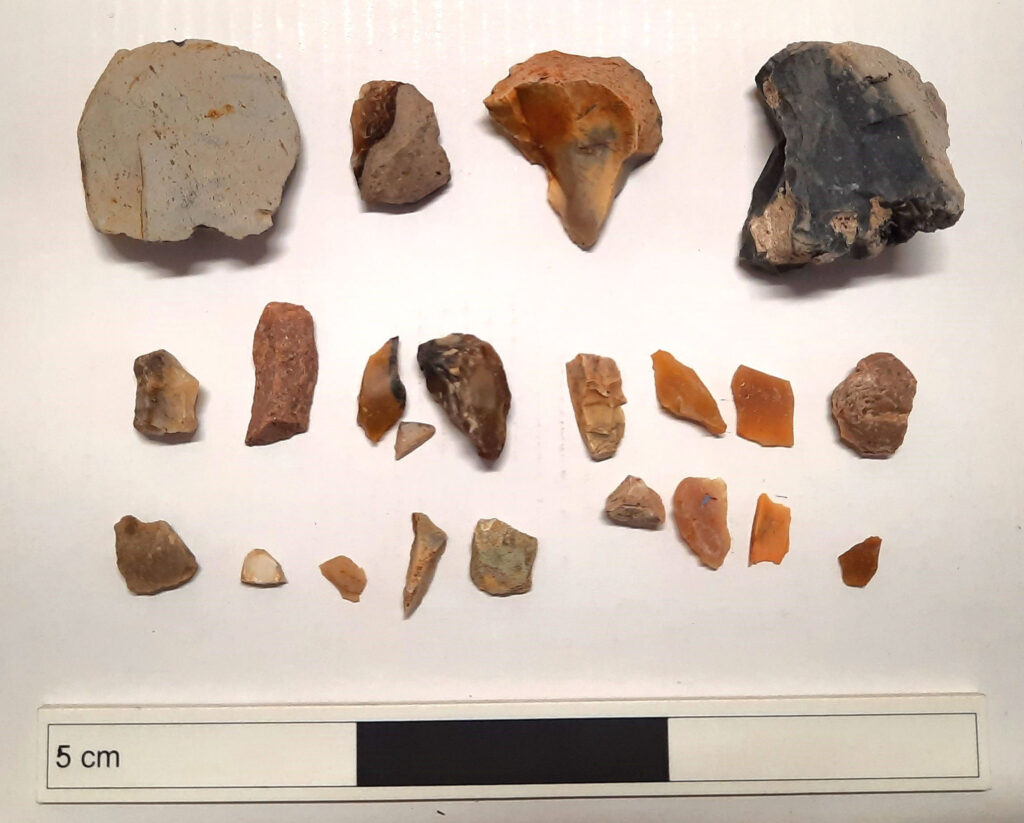
Over 480 lithic artefacts were found during the works at Staffin, most of which date to the Early and Late Mesolithic with some possibly from the Late Upper Palaeolithic. They were made from different stone types found at Staffin, most of which comprised flint and Staffin baked mudstone, and smaller amounts of Durness chert, quartz, dolerite, and Rum bloodstone. The artefacts recovered from the shoreline comprised mainly debitage (the waste flakes produced during knapping) with a smaller number of tools and cores (the leftover centre of the raw material after knapping).


Selection of worked Mesolithic material
Mesolithic stone tools are often called microliths due to their very small size, often less than 1cm in length. At Staffin, these tiny tools were used as blades, scrapers, drill bits, and microburins (small chisel-like tools). These tools would have been used for everyday tasks, such as hunting, cooking, and working with other materials like wood, antler and skins.

This artistic reconstruction shows a possible flint knapping scene. The initial stage would involve splitting the flint pebbles, then a bone, antler or wooden tool might have been used for the more detailed shaping.
explore the 3D model⚬
explore the 3D model⚬
explore the 3D model⚬
explore the 3D model⚬
explore the 3D model⚬
Bipolar Core
New Discovery
Specialist analysis of the stone tools by Torben Ballin identified six pieces made from a type of stone not previously known to have been used for knapped stone tools in the Inner Hebrides. This was a distinctive type of dense crystalline rock with a fine-grained matrix and containing shiny phenocrysts to give it a somewhat spectacular appearance. The group included two flakes, one blade, one indeterminate piece, one bipolar core and one expedient side-scraper.

Bipolar Core

Flake

Blade
explore the 3D model⚬
explore the 3D model⚬
explore the 3D model⚬
explore the 3D model⚬
explore the 3D model⚬
Boat Nausts
The boat nausts were small rectangular boat shelters built in the 20th century. Excavation of the nausts before their demolition revealed more to them than just walls. Below the turf, archaeologists found slabbed surfaces and stone lined drainage channels. The foundations of earlier walls were also found, suggesting the present nausts were built on top of earlier buildings.


